skip to main |
skip to sidebar
A quick report from the field: Magee Marsh, Ottawa NWR and Metzger Marsh, May 11-13. The weather conspired against me during my 2 1/2 days of birding the "Warbler Capital of the World" and the Biggest Week in American Birding. It was cold, gray, wet, and rather miserable. Let's just say, I have had better trips here. However, a bad day at Magee is better than a good day just about anywhere else in the world, so I'm still satisfied.
I ended up with a Trip List of 99 species, 19 of them warblers. I missed the Kirtland's Warbler by 1.5 days, the Mourning Warbler, the Golden-winged Warbler, and the Black-billed Cuckoo by hours, the Canada Warbler by minutes, and numerous other birds that should have been easy for numerous other reasons.
I missed getting my life Orange-crowned Warbler twice. A guy on the board walk told me he was "90% sure" that the tiny, backlit bird way, way high in the tree tops was an Orange-crowned. My own personal rule for Life Birds requires that I see the bird well enough to be able to ID it again in the future. I couldn't do it, so I didn't count it. Two days later, I saw a small, drab warbler working the edge of the parking lot, and thought I had an Orange-crowned. I studied it carefully, looking for every possible field mark. I narrowed it down to two species, and talked to Kim Kaufman in the BSBO office to help me confirm or deny my ID. I thought I had it, but on further review, I have decided I didn't seen the undertail coverts well enough to determine their color, and the rest of the field markings and behavior have made me conclude I had a female Tennessee instead.
I did pad my trip list a bit by counting two birds seen only "in-hand" at the banding demonstration put on by Black Swamp Bird Observatory.  The tent set up just outside the BSBO building was crowded with observers, and I only stayed a few minutes. I picked up photos of this Northern Waterthrush, held by Kim Kaufman
 and this Black-capped Chickadee held by Mark Shieldcastle. I was trying to show its field marks, including the white frosting on the wings. Bill Thompson, III calls that mark a "hockey stick," and I can never see in the field. I prefer to use the smudgy edges of its bib, compared to the clean lines of a Carolina, but that photo was unusable.
 I got a decent shot of a male Baltimore Oriole along the causeway at Metzger Marsh, but the female flew before I could bag her. I took very few pictures on this trip. It rained most of the time, and when it wasn't raining, the light was terrible.
 My favorite photo was of these Barn Swallows, who were assessing the housing potential of the sign on the door at the Bird Center at Magee Marsh. This door opens and closes every couple of minutes all day long in spring, and I imagined the conversation went something like this:
 male: "Honey? What about here? This looks like a good spot."
female: "No, I told you over and over again. There is too much traffic here."
male: (mutters under his breath)
female: "What? I heard that. What did you say?"
male: "I said, 'Yes, dear.'"
female: (flying off) "My mother was right about you."
My complete trip list:
Canada Goose
Trumpeter Swan
Wood Duck
Gadwall
Mallard
Blue-winged Teal
Bufflehead
Ruddy Duck
Ring-necked Pheasant
Pied-billed Grebe
Double-crested Cormorant
Great Blue Heron
Great Egret
Black-crowned Night-Heron
Turkey Vulture
Osprey
Bald Eagle
Cooper's Hawk
Red-tailed Hawk
American Kestrel
Sora (HO=heard only)
Common Moorhen
American Coot
Killdeer
Spotted Sandpiper
Solitary Sandpiper
Greater Yellowlegs
Lesser Yellowlegs
Least Sandpiper
Dunlin
American Woodcock (doing his "sky dance")
Ring-billed Gull
Herring Gull
Black Tern
Forster's Tern
Mourning DOve
Chimney Swift
Ruby-throated Hummingbird
Red-bellied Woodpecker
Downy Woodpecker
Least Flycatcher
Eastern Phoebe (HO)
Eastern Kingbird
Warbling Vireo
Red-eyed Vireo
Blue Jay
American Crow
Horned Lark (HO)
Purple Martin
Tree Swallow
Barn Swallow
Bank Swallow
Black-capped Chickadee
House Wren
Ruby-crowned Kinglet
Veery
Gray-cheeked Thrush
Wood Thrush (HO)
American Robin
Gray Catbird
Brown Thrasher
European Starling
[warblers]
Tennessee (female)
Northern Parula
Yellow
Chestnut-sided
Magnolia
Cape May
Black-throated Blue
Yellow-rumped
Black-throated Green
Blackburnian
Palm (female)
Bay-breasted
Blackpoll (female)
Black-and-white
American Redstart
Prothonotary (pair at nest cavity)
Ovenbird
Northern Waterthrush
Common Yellowthroat
[19 total warblers]
Eastern Towhee (HO)
Chipping Sparrow
Song Sparrow
White-throaed Sparrow
White-crowned Sparrow
Northern Cardinal
Rose-breasted Grosbeak (3 M/2 F at one feeder)
Indigo Bunting
Bobolink (!)
Red-winged Blackbird
Eastern Meadowlark
Yellow-headed Blackbird (female; 1st Ohio)
Common Grackle
Brown-headed Cowbird
Baltimore Oriole
House Finch
American Goldfinch
House Sparrow
total 99 species
I also saw lots of birders, including both old friends and new. I had a lot of fun meeting and birding with Alan Davies, a professional bird guide from Wales (they call birding "twitching" over there, you know) and hearing his stories. He and his wife took a year off work to travel and bird the world, in an attempt to break the record for the number of species seen in a calender year. The previous record was 3662; Alan and his wife, Ruth Miller, beat that on Oct. 31, 2008. Their final total was 4341! You can read about "The Biggest Twitch" here.
My 100th bird of the trip was a Life Bird, and it was well worth the two hour detour from NW Ohio to Columbia Station Reservation in Lorain County, just west of Cleveland. This was it, a Purple Gallinule, a tropical/subtropical bird that has no business being in northern Ohio. This one has been hanging around a Metropark for a couple of weeks, and it became my own personal "twitch" to chase down this vagrant.
 Can you find the bird in this mess of spatterdock?
Well, I did, and it was great!
Those of you who read my blog for my (occasional) bird posts are going to be a bit disappointed. I get my new puppy tomorrow, a 10 week old female Boston Terrier named "Panda," and I predict the blog will be filled with puppy stories for quite a while. I'll try not to gush too much or grouse too often, and I'll try to mix up puppy tales with pottery and nature, too.
 After registering for the 10th annual "Shreve Migration Sensation" at 7:00am, I elected to start my birding day at a wildlife area with the humorous name of "Funk Bottoms." Here, off SR95, is an observation tower that overlooks nearly 2000 acres of flooded agricultural fields, filled with waterfowl of all sorts. The pools also harbored a busy population of muskrats, doing their spring cleaning and making repairs to their huts.
 From the platform, I had great looks though my spotting scope at Northern Pintails, Green-winged Teal, Northern Shovelers, Mallards, Canada Geese, a few Buffleheads, a pair of Hooded Mergansers, and more Ring-necked Ducks than you could shake a stick at. Here, too, I saw a leucistic Red-tailed Hawk, whose white wing patches had me scratching my head for a bit. I was lucky enough to see a single Sandhill Crane fly overhead. Of course, the wetlands was filled with hormonal male Red-winged Blackbirds (and only one female that I saw.) The only sparrows I was able to find were Song.
There were also quite a few Wood Ducks at Funk Bottoms, swimming, flying, calling with their funny squeaky whistles, and even one pair imitating Barn Swallows. Who needs a simple Wood Duck box, when you can nest here?
 I know it's hard to see, but trust me, there is a Wood Duck drake balanced on the metal hook protruding from the barn, and his lady is resting in the small entry hole nearby. They seemed to be bonded to this site, and kept coming back to inspect it from all angles.
 I even saw him perched casually on the wire to the right. A duck, perching on a wire - incredible!
On my way out of the drive, I was happy to find two of a flock of 20 or more Rusty Blackbirds, reported by a carload of birders who were kind enough to back up the lane and let us know about their discovery. Thanks! Ring-billed and Boneparte's Gulls, Eastern Towhee, Northern Cardinal, and the only House Sparrow of the day rounded out my list for the Bottoms.
Next, I stopped by Brown's Bog, but the icy boardwalk made me think twice about exploring this area. I'll have to return in warmer weather to see the pitcher plants and other specialty flora. A brief stop at Shreve Lake yielded a Common Merganser, a Horned Grebe, my first Great Blue Heron of the day, and birder Su Snyder, who very sweetly shared her birds and her knowledge, but wouldn't let me take her picture. I'll get you another time, Su!
From Shreve Lake, I had planned to visit the Bald Eagle nest site, but somehow, I got a little, well - lost. Let's just say, one shouldn't bird and drive while trying to read a map. Something always suffers.
However, in my quest to find myself and the eagles, I did get some birds that I wouldn't have seen otherwise - a Killdeer, an American Goldfinch, molting into his summer garb, and a lovely pair of Eastern Bluebirds. I also saw this:
 (Now you know who makes those plain Amish shirts, pants, and dresses.)
and this:
 and this.
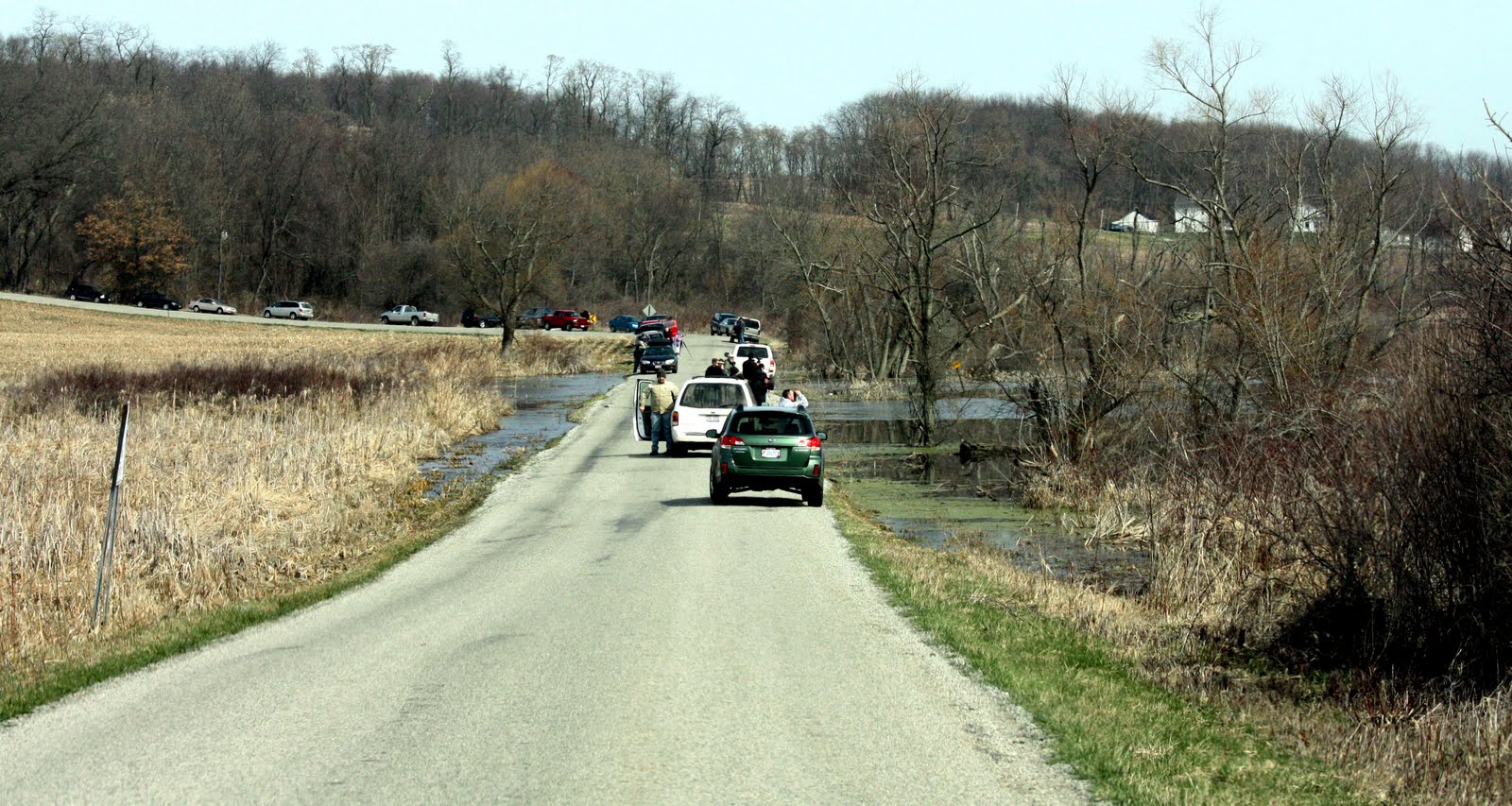
 Yes, people were stupid enough to drive through this flooded spot on County Rd. 1, despite the warning signs. I didn't think the water looked that high, but the current seemed quite strong. I elected to turn around and head back. I'm glad I did, since this little ovine family was only visible on my return trip back County Rd. 8.


 Doesn't that make you say "awwwww?"
After all the effort, and the cute overload, the Bald Eagle nest was a bit anti-climatic. From over a half-mile away, my look was limited to a tuft of white feathers sticking up from a pile of sticks. Not very satisfying. I have been spoiled by the close views I have had of our local eagle nest over the years. Instead of brooding, I turned my back on the eagle and my scope on yet another flooded field. I was rewarded with American Wigeon, my first Tree Swallows of the year, and a heard-only Northern Flicker.
This is always a good sign - other birders stopped along the road. This is Cemetery Rd., and it is here that I found American Coots, Redheads, and a Ruddy Duck.
Along the roads, other several birds were added to my list for the day - American Robin, Common Grackle, American Crow, Mourning Dove, Rock Pigeons, a Cooper's Hawk, and a Turkey Vulture on the ground that I first thought was a turkey, until I realized it was eating a carcass while trying to defend it from two aggressive crows.
I had intended to attack the Wright Marsh section of Killbuck Marsh Wildlife Area next, but after hiking back to a series of pools and levies, I noticed it was nearly lunch time. Over-ruled by my stomach, I abandoned the promise of more waterfowl, including rumored Tundra Swans, and drove back to the Shreve Elementary School, the hub of the day's events.After lunch and a quick cruise through the Birders' Market, I settled in to hear this "rare bird," Jim McCormac, share his observations of the rare birds have recently appeared in Ohio, and his thoughts on which species might be next to show up in our state. (Fish Crow and Ash-throated Flycatcher were two of his top three, in case you were wondering.)
 Before Jim's talk, I was able to see another Ohio rarity in person, this gorgeous Snowy Owl.
 Isn't she lovely?
By now, it was 2:30pm. I had been birding since dawn and faced a 5 hour drive home, so I decided to call it quits. I missed a lot, it seems, and will have to return to Wayne County for more birding adventures, but even in the parking lot of a birding festival, photo ops happen.In Amish country, bicycles are a common mode of transportation for birders but I was more amused by the horse and buggy I found parked next to a row of cars and SUVs.
 Did you ever want to peek inside an Amish buggy? I have, but after shooting one picture, I felt as though I was intruding and backed off.
 Thank you, residents of Shreve, Friends of Killbuck Marsh, and the Greater Mohican Audubon Society, for inviting us to share your great outdoors. In the words of the Govern-ator, "Ah'll be bahk."
 The tent set up just outside the BSBO building was crowded with observers, and I only stayed a few minutes. I picked up photos of this Northern Waterthrush, held by Kim Kaufman
 and this Black-capped Chickadee held by Mark Shieldcastle. I was trying to show its field marks, including the white frosting on the wings. Bill Thompson, III calls that mark a "hockey stick," and I can never see in the field. I prefer to use the smudgy edges of its bib, compared to the clean lines of a Carolina, but that photo was unusable.
 I got a decent shot of a male Baltimore Oriole along the causeway at Metzger Marsh, but the female flew before I could bag her. I took very few pictures on this trip. It rained most of the time, and when it wasn't raining, the light was terrible.
 My favorite photo was of these Barn Swallows, who were assessing the housing potential of the sign on the door at the Bird Center at Magee Marsh. This door opens and closes every couple of minutes all day long in spring, and I imagined the conversation went something like this:
 male: "Honey? What about here? This looks like a good spot."
 Can you find the bird in this mess of spatterdock?