Showing posts with label Birds. Show all posts

Sunday, June 27, 2010

Birds from Potholes and Prairies

Swainson's Hawk - taken through a fogged-up bus window, this photo does not do him justice.
Ferruginous Hawk - nearly as big as an eagle, and even more impressive when seen perched by the side of the road, on the right-of-way post, and showing all his field marks.
White Pelican. Not a life bird for me, but I still gasped every time I saw these guys. Big white birds impress southern Ohio birders - we don't see too many in our local patches.
Western Grebe - Lifer! Later, I also saw the Clark's Grebe, which looks very similar. My 1980 4th edition of Peterson's Field Guide, eastern version, shows the Clark's as a pale morph of the Western. By the time my third edition of Peterson's Western Birds was published, in 1990, the Western Grebe was split and Clark's Grebe was named as a separate species.
Say's Phoebe - another Lifer.

Common (formerly Wilson's) Snipe was not a life species, but this behavior was quite new for me. I'm used to snipes staying low on the ground, not T-ed up on fence posts. This must be a prairie thing, as we saw many birds doing this.
Bobolinks. Lovely to see and to listen to, trouble to photograph. Here are my best efforts.
One of the fun things about North Dakota is how East meets West. This was really driven home to me by the overlap of two tyrant flycatcher species - the Eastern Kingbird, which lives and nests in my back yardand the very different Western Kingbird, a new species for me.
The Western Meadowlark looks nearly identical to the more familiar eastern species, but his song was quite different.
The ubiquitous Red-winged Blackbird was joined by the beautiful, but much less musical, Yellow-headed Blackbird, a very shy guy when it comes to having his picture taken.
All in all, I got 107 species of birds in four days, including the following 25 Life Birds:

Sharp-tailed Grouse
Red-necked Grebe
Western Grebe
Clark's Grebe
Swainson's Hawk
Ferruginous Hawk
Yellow Rail (heard only)
Piping Plover
American Avocet
Willet
Upland Sandpiper
Marbled Godwit
White-rumped Sandpiper
Wilson's Phalarope
Say's Phoebe
Western Kingbird
Loggerhead Shrike
Spague's Pipit
Clay-colored Sparrow
Vesper Sparrow
Baird's Sparrow
LeConte's Sparrow
Nelson's (Sharp-tailed) Sparrow
Chestnut-collared Longspur
Western Meadowlark

In addition, I saw my first USA Grey Partridge (my Lifer was in Scotland in 1999) and a Krider's hawk (not a separate species, but a pale morph of Red-tailed Hawk.)

I definitely recommend the Potholes and Prairies birding festival of North Dakota for both
eastern and western birders. Look in your favorite field guide. This is where the range maps overlap, and everybody has a chance of seeing some life birds.

Friday, May 14, 2010

Magee Report, 2010

A quick report from the field: Magee Marsh, Ottawa NWR and Metzger Marsh, May 11-13. The weather conspired against me during my 2 1/2 days of birding the "Warbler Capital of the World" and the Biggest Week in American Birding. It was cold, gray, wet, and rather miserable. Let's just say, I have had better trips here. However, a bad day at Magee is better than a good day just about anywhere else in the world, so I'm still satisfied.

I ended up with a Trip List of 99 species, 19 of them warblers. I missed the Kirtland's Warbler by 1.5 days, the Mourning Warbler, the Golden-winged Warbler, and the Black-billed Cuckoo by hours, the Canada Warbler by minutes, and numerous other birds that should have been easy for numerous other reasons.

I missed getting my life Orange-crowned Warbler twice. A guy on the board walk told me he was "90% sure" that the tiny, backlit bird way, way high in the tree tops was an Orange-crowned. My own personal rule for Life Birds requires that I see the bird well enough to be able to ID it again in the future. I couldn't do it, so I didn't count it. Two days later, I saw a small, drab warbler working the edge of the parking lot, and thought I had an Orange-crowned. I studied it carefully, looking for every possible field mark. I narrowed it down to two species, and talked to Kim Kaufman in the BSBO office to help me confirm or deny my ID. I thought I had it, but on further review, I have decided I didn't seen the undertail coverts well enough to determine their color, and the rest of the field markings and behavior have made me conclude I had a female Tennessee instead.

I did pad my trip list a bit by counting two birds seen only "in-hand" at the banding demonstration put on by Black Swamp Bird Observatory.
The tent set up just outside the BSBO building was crowded with observers, and I only stayed a few minutes. I picked up photos of this Northern Waterthrush, held by Kim Kaufman
and this Black-capped Chickadee held by Mark Shieldcastle. I was trying to show its field marks, including the white frosting on the wings. Bill Thompson, III calls that mark a "hockey stick," and I can never see in the field. I prefer to use the smudgy edges of its bib, compared to the clean lines of a Carolina, but that photo was unusable.
I got a decent shot of a male Baltimore Oriole along the causeway at Metzger Marsh, but the female flew before I could bag her. I took very few pictures on this trip. It rained most of the time, and when it wasn't raining, the light was terrible.
My favorite photo was of these Barn Swallows, who were assessing the housing potential of the sign on the door at the Bird Center at Magee Marsh. This door opens and closes every couple of minutes all day long in spring, and I imagined the conversation went something like this:
male: "Honey? What about here? This looks like a good spot."
female: "No, I told you over and over again. There is too much traffic here."
male: (mutters under his breath)
female: "What? I heard that. What did you say?"
male: "I said, 'Yes, dear.'"
female: (flying off) "My mother was right about you."

My complete trip list:

Canada Goose
Trumpeter Swan
Wood Duck
Gadwall
Mallard
Blue-winged Teal
Bufflehead
Ruddy Duck
Ring-necked Pheasant
Pied-billed Grebe
Double-crested Cormorant
Great Blue Heron
Great Egret
Black-crowned Night-Heron
Turkey Vulture
Osprey
Bald Eagle
Cooper's Hawk
Red-tailed Hawk
American Kestrel
Sora (HO=heard only)
Common Moorhen
American Coot
Killdeer
Spotted Sandpiper
Solitary Sandpiper
Greater Yellowlegs
Lesser Yellowlegs
Least Sandpiper
Dunlin
American Woodcock (doing his "sky dance")
Ring-billed Gull
Herring Gull
Black Tern
Forster's Tern
Mourning DOve
Chimney Swift
Ruby-throated Hummingbird
Red-bellied Woodpecker
Downy Woodpecker
Least Flycatcher
Eastern Phoebe (HO)
Eastern Kingbird
Warbling Vireo
Red-eyed Vireo
Blue Jay
American Crow
Horned Lark (HO)
Purple Martin
Tree Swallow
Barn Swallow
Bank Swallow
Black-capped Chickadee
House Wren
Ruby-crowned Kinglet
Veery
Gray-cheeked Thrush
Wood Thrush (HO)
American Robin
Gray Catbird
Brown Thrasher
European Starling
[warblers]
Tennessee (female)
Northern Parula
Yellow
Chestnut-sided
Magnolia
Cape May
Black-throated Blue
Yellow-rumped
Black-throated Green
Blackburnian
Palm (female)
Bay-breasted
Blackpoll (female)
Black-and-white
American Redstart
Prothonotary (pair at nest cavity)
Ovenbird
Northern Waterthrush
Common Yellowthroat
[19 total warblers]
Eastern Towhee (HO)
Chipping Sparrow
Song Sparrow
White-throaed Sparrow
White-crowned Sparrow
Northern Cardinal
Rose-breasted Grosbeak (3 M/2 F at one feeder)
Indigo Bunting
Bobolink (!)
Red-winged Blackbird
Eastern Meadowlark
Yellow-headed Blackbird (female; 1st Ohio)
Common Grackle
Brown-headed Cowbird
Baltimore Oriole
House Finch
American Goldfinch
House Sparrow

total 99 species

I also saw lots of birders, including both old friends and new. I had a lot of fun meeting and birding with Alan Davies, a professional bird guide from Wales (they call birding "twitching" over there, you know) and hearing his stories. He and his wife took a year off work to travel and bird the world, in an attempt to break the record for the number of species seen in a calender year. The previous record was 3662; Alan and his wife, Ruth Miller, beat that on Oct. 31, 2008. Their final total was 4341! You can read about "The Biggest Twitch" here.

My 100th bird of the trip was a Life Bird, and it was well worth the two hour detour from NW Ohio to Columbia Station Reservation in Lorain County, just west of Cleveland. This was it, a Purple Gallinule, a tropical/subtropical bird that has no business being in northern Ohio. This one has been hanging around a Metropark for a couple of weeks, and it became my own personal "twitch" to chase down this vagrant.

Can you find the bird in this mess of spatterdock?
Well, I did, and it was great!

Those of you who read my blog for my (occasional) bird posts are going to be a bit disappointed. I get my new puppy tomorrow, a 10 week old female Boston Terrier named "Panda," and I predict the blog will be filled with puppy stories for quite a while.
I'll try not to gush too much or grouse too often, and I'll try to mix up puppy tales with pottery and nature, too.

Thursday, May 13, 2010

But, did you see birds?

Right about now, I can hear my birding friends saying, "Enough, already, with the tram ride and the boat ride and even the river. Didn't you take any bird photos while you were in the New River Gorge area?"

Here you are - the best of my bird pictures from last week:
Don't laugh and say, "It's just a robin." Good birders look at all the birds, even the common backyard ones. Nascent photographers like me appreciate robins because they are big enough, close enough, and patient enough to allow one to fiddle with the camera settings. This is my first bird portrait after attending Wil's 2 hour photography class, in Manual mode. Imagine what I could accomplish if I took one of his weekend workshops!

Studies in black, white, and shades of gray:
Carolina Chickadee
White-breasted Nuthatch

You all know whose hand this is.
Ruby-throated Hummingbird

For my friend Lynne of Hasty Brook:
Turkey Vulture

an elusive singer, hiding in the bushes at Meadows House
Carolina Wren

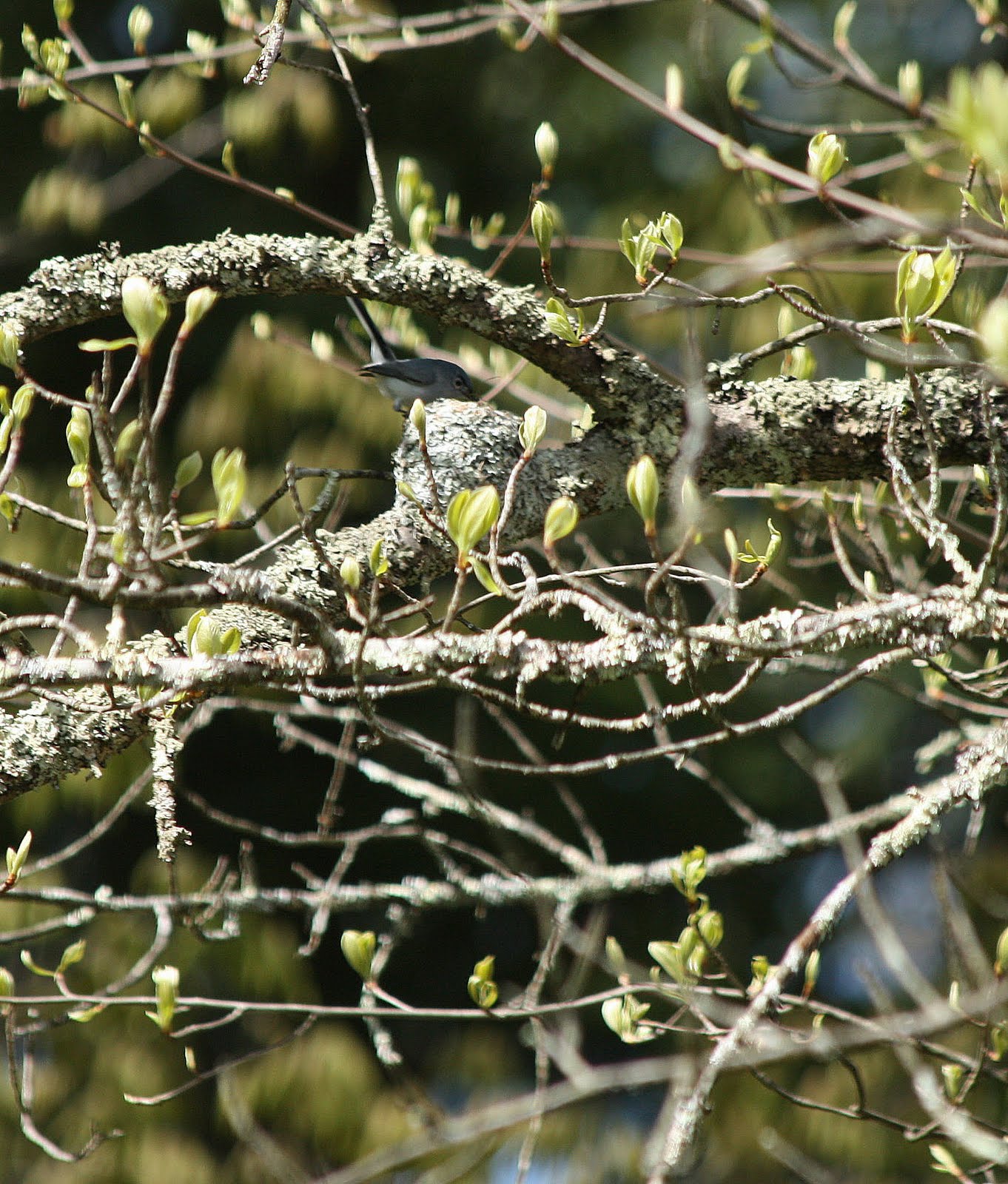
How to photograph a flitty little bird:
Focus on the lichen-covered nest and wait.Set your camera on "continuous" mode and keep shooting.
Sooner or later, you get lucky.Blue-gray Gnatcatcher

At a bird banding, don't blink
or you'll miss the moment of release.
Good-bye to spring birding in the New River valley.
See you next year!

I'm already making plans for New River, 2011. Dates are May 2-7. Will you Flock with us?

Saturday, February 13, 2010

Great Backyard Bird Count 2010

If you haven't heard already, this weekend is the Great Backyard Bird Count. It is a citizen scientist project that anyone can participate in. Simply watch the birds in your backyard for a few minutes, a few hours, or all weekend, and submit your list to the Cornell Lab of Ornithology's web site at the link above. With luck, you might see birds like these:

American Tree Sparrow
Can you see the bicolored bill?
Song SparrowWhite-throated SparrowCompare the American Tree Sparrow (left)
with the White-throated Sparrow (right)

Eastern Towhee, male
See his red eye?
from left to right: White-throated Sparrow,
Carolina Wren, Eastern Towhee

Red-bellied Woodpecker, male
And you can even see his red belly!
Downy Woodpecker, male
male House Finch (left) eating safflower seeds
female Downy Woodpecker (right) on peanut feeder

All photos enlarge with a click.

There's still plenty of time - the Count runs through Monday, Feb. 15. Fill up your feeders and start counting birds!
the ultimate winter bird,
a male Northern Cardinal

Tuesday, January 19, 2010

OOS at The Wilds: Year 2

Blogging had become something of a chore, rather than a pleasure, so I took a little un-announced leave of absence. Thanks to gentle (and sometimes not-so-gentle) nudges from loyal fans, I have been encouraged to get back on board. Here is a tale of the Ohio Ornithological Society's 2010 trip to The Wilds.

The Wilds, in case you have forgotten, is an area of Muskingum County, Ohio that was destroyed by surface mining for coal in the 60's
and 70's. In surface mining, aka strip mining, huge machines were used to strip all the vegetation and top soil off shallow coal deposits. Mining companies kept the coal and trashed the rest of what used to be beautiful rolling hills. See my post here about The Wilds, a home for endangered animals, that is breathing new life into this once barren land.Nest boxes for American Kestrels, provided by the OOS, dot the property around The Wilds.

Every year, the OOS sponsors a trip to The Wilds to look for its other form of wildlife, wintering raptors. The target species are Rough-legged Hawks
, Northern Harriers, Red-tailed Hawks, American Kestrels, and Short-eared Owls. If you are lucky, you might even find a Merlin or a Golden Eagle spending their winters in this unique Ohio habitat. Non-raptor species are here, too - Horned Larks, American Tree Sparrows, and the elusive Northern Shrike could be around the next corner or over the next field.Last January was my first winter field trip to The Wilds. Regular blog readers will remember that it was cold. How cold? DARNED COLD, as in -18 F in the morning, even without the bitter, cutting wind that constantly blows across the landscape. I swore never to return. I'm glad I didn't keep that resolution.

The weatherman predicted temps in the 30's for the weekend of Jan. 16-17. "Remember," Julie said, "Thirty degrees at The Wilds is like ten degrees anywhere else." Who cares? I was going birding with friends - Julie Zickefoose and Bill Thompson III, Nina of Nature Remains and her husband, Tony, fellow OOS'ers like Anne Oliver, Jim McCormac, Peter King, Marc Nolls, Cheryl Harner, and many more. Plus, the announcement promised a special treat this year. Who could resist?
Mad birders line the roads, scanning the horizon for raptors. Do you see the Golden Eagle? Neither did we.

We did see plenty of Rough-legged Hawks. Here are a couple of ID tips for you, courtesy of trip leader extraordinaire, Mr. BT3.

One: Long wings, a long tail, and dark "wrist patches." This bird is a light morph - they also have a darker form.
Two: Since Rough-legged Hawks are birds of the tundra, where they nest on the ground and don't see many trees, they have tiny feet. They can perch on much smaller branches than a hawk like the Red-tailed. So, when trying to distinguish between the two, the hawk perched on skinny branches at the tip of the tree is more likely to be a Rough-legged; one on a large branch near the trunk of a tree is a Red-tailed.We also saw lots and lots of White-tailed Deer. They seem to know they are safe from hunters within The Wilds' perimeter fence, and are abundant here.
This protected little spot, with its rivulets of melted ice and snow, was full of bathing American Tree Sparrows. At first, I thought they were the Horned Larks we were seeking, and was embarrassed by missing the ID. Later, a much more experienced birder than I made the same mistake. Whew! I'm not alone in making bad calls.
Cow fields. "The place" for Horned Larks, promised Bill, and he was right, as usual.
Lucky us, we had a way to direct everyone in our group to the birds. The White Cow was our official landmark. She must have been the most popular cow in Muskingum County that day.
The Horned Larks are to the left and behind the White Cow. Honest.

In contrast to last year's low of -18, the temps this year started out in the upper 20's and we hit a high of 52 degrees. That's 70 degrees warmer than Jan., 2009 - and no wind! Ohio weather is just like a box of chocolates; you never know what you are going to get.

In between looking for birds, we found other amusements. Like, trying to take a photo of a camera-shy blogger. Gotcha, Nina!
Other bloggers are much less concerned about having their picture taken. Guess who?An unofficial hat contest broke out, the contestants vying for the honor of looking like Elmer Fudd.
Bored children threw slush balls and built slush-men. (The snow was melting too quickly for a true snowball fight to break out.)Later groups, passing this spot, would announce on their walkie-talkies: "Looks like Phoebe and Liam have been here!"

As the afternoon turned into evening, dozens of hopeful birders gathered at the birding station at Jeffery Point, hoping for Short-eared Owls at twilight. No owls deigned to appear.

Oh, and that promised surprise? Come back in a day or two - all will be revealed.